How Flashing Failures Cause Roof Leaks
Flashing failures roof leaks Whittier CA homeowners deal with every rainy season start at seams, valleys, and penetrations. Here is why they fail and how we fix them.
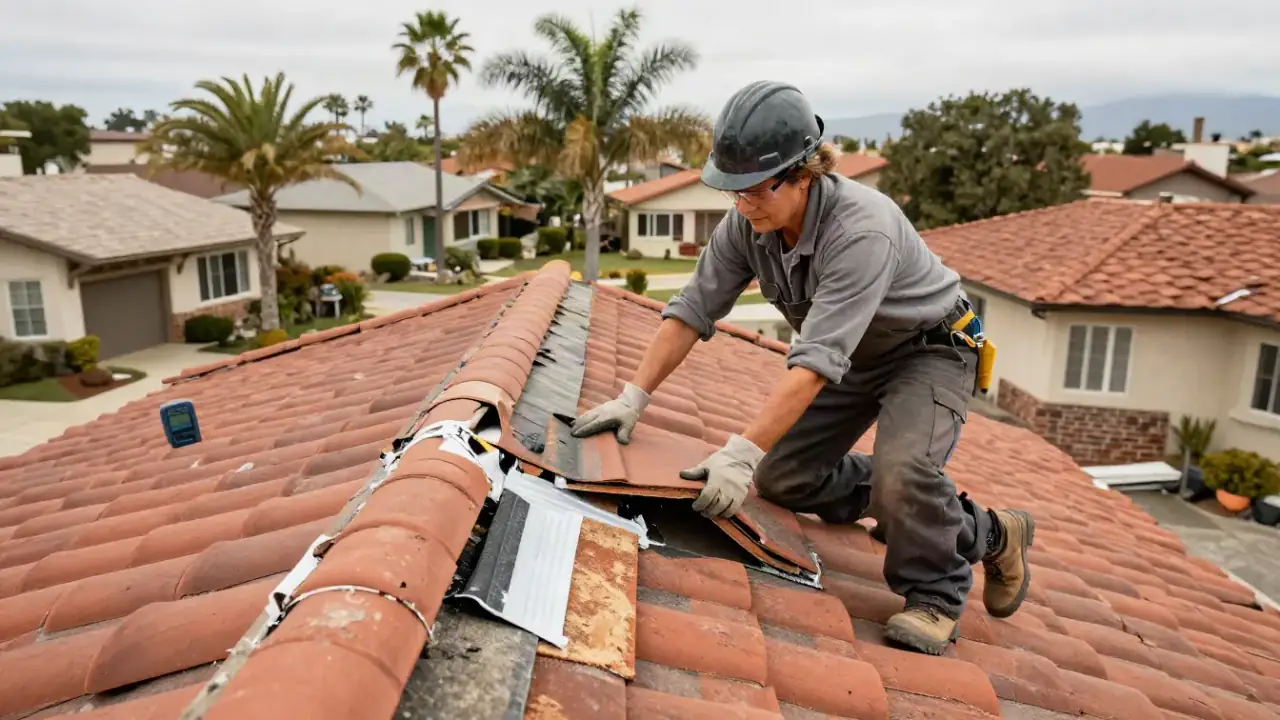
Flashing failures cause roof leaks because the metal that seals your roof's edges, valleys, and penetrations eventually pulls loose, corrodes, or gets sealed with the wrong material - and water finds that gap within minutes of the first hard rain. In Whittier, most of the leaks we open up in October and November trace back to flashing that was either installed wrong years ago or simply aged out. This post covers what flashing actually does, the six failure modes we see most in Whittier, the warning signs to watch for, and how we repair each one.
What Roof Flashing Does and Why It Fails
Flashing failures roof leaks Whittier CA homeowners deal with are almost always a sealing problem, not a roofing-material problem. Flashing is the shaped metal - usually galvanized steel, aluminum, or copper - that protects every place your roof changes direction or gets interrupted by something else.
That means chimneys, vent pipes, skylights, wall-to-roof transitions, valleys, and the drip edge along your eaves. Roof shingles and tiles shed water fine on their own. Flashing handles the hard spots where water wants to pool, funnel, or run sideways.
Flashing fails for four reasons: thermal cycling, corrosion, bad installation, and incompatible sealants. Whittier sits in a climate that swings from 100-degree summer afternoons to 45-degree winter mornings, and that daily expansion and contraction works every fastener and seam loose over time. Add our occasional Santa Ana wind events and the seasonal rain we get from November through March, and you have a recipe for metal that pulls away from the surface it was supposed to seal.
If you want a broader look at how we handle leaks across the city, our Roof Leak Repair Whittier CA page covers the full scope of what we do.
The Six Most Common Flashing Failures We Find in Whittier
Flashing failure causes Whittier California leaks in six repeatable ways, and once you know them you can spot the early warning signs yourself.
1. Lifted or Separated Step Flashing
Step flashing runs up the side of a chimney or wall in individual L-shaped pieces, one per course of shingles. When the fasteners back out or the pieces were never woven into the shingle courses correctly, water runs behind them and straight into your attic. This is the single most common cause of chimney leaks we see.
2. Cracked or Missing Sealant at Pipe Boots
Every plumbing vent and exhaust pipe that comes through your roof has a rubber boot around it. That rubber dries out and cracks in five to eight years of Whittier sun. Once it splits, water runs down the pipe and into the ceiling below. We handle these with Vent and Pipe Boot Leak Repair Whittier CA - it is a fast, inexpensive fix when caught early.
3. Corroded Valley Metal
Valleys take the most water volume of any part of your roof. The metal in the valley can rust through or get punctured by debris, and once it does, every storm sends water under your shingles. This is where a Valley Leak Repair Whittier CA call usually starts.
4. Failed Counter-Flashing at Headwalls
Counter-flashing is the metal cap that covers the top edge of step flashing where it meets a vertical wall. When it lifts, water gets behind the whole assembly. We see this constantly on 1950s and 1960s homes in the older parts of Whittier.
5. Skylight Curb Flashing That Has Pulled Loose
Skylights have a raised curb, and the flashing around that curb is a common weak point. If the sealant has dried out or the metal has separated, you get a leak that shows up as a ceiling stain well away from the skylight itself. Our Skylight Leak Repair Whittier CA service starts with tracing the actual entry point, not just resealing the frame.
6. Drip Edge and Gable Flashing That Was Never Sealed
Drip edge along the eaves and rake is supposed to direct water into the gutter. When it is installed without the proper underlayment lap, wind-driven rain gets behind it and rots the fascia. This one is easy to miss from the ground.
How Do Flashing Failures Cause Roof Leaks in Whittier CA?
Flashing failures cause roof leaks in Whittier CA by creating a path for water to bypass the shingles entirely - the shingles shed water over the top, but flashing is what seals the edges, and when it separates, water goes straight under. Shingles are a drainage layer, not a waterproof layer. The waterproofing comes from the underlayment beneath them, and flashing is what keeps water from getting to the underlayment in the first place.
When flashing fails, water enters at the gap, runs along the roof deck or a rafter, and shows up somewhere else - often 6 to 15 feet from the actual leak. That is why chasing a ceiling stain from inside the attic rarely works. You have to get on the roof and test the suspect flashing with a hose.
We do that test with a two-person crew: one on the roof with the hose, one in the attic with a flashlight. We start low and work up, one section at a time, until the drip shows. That is how we find the real entry point instead of guessing. If the leak has already stained your ceiling, we also offer Ceiling Water Stain and Moisture Investigation Whittier CA to confirm the source and check for hidden moisture.
What Are the Signs of Flashing Failure in Whittier California?
Signs of flashing failure in Whittier California show up both inside and outside the house, and the outside signs are usually visible weeks before water gets in. Check these after any rainstorm:
- Brown or rust-colored streaks on the flashing itself - the metal is corroding from the inside out.
- Lifted or curling metal edges at chimneys, walls, or skylights. If you can slide a putty knife under it, water can get under it.
- Cracked, chalky, or missing sealant at any roof penetration. Sealant should be pliable, not brittle.
- Rust stains on the fascia or soffit below the roofline - a sign water is running behind the drip edge.
- Granules or debris piled in the valley, which traps moisture against the valley metal.
- Ceiling stains, bubbling paint, or a musty smell in the attic after a storm. These mean water is already getting in.
If you see any of these, do not wait for the next storm. A $400 flashing repair in 2026 is a lot cheaper than the drywall, insulation, and framing work that follows a slow leak you ignored for a season.
How Is Flashing Leak Repair Done in Whittier?
Flashing leak repair in Whittier is a three-step job: find the actual entry point, remove and replace the failed flashing (not just seal over it), and water-test the repair before we leave. We do not patch flashing with roof cement and call it done. That is a temporary fix that fails within one or two rainy seasons.
Here is the process we follow on every flashing call:
- Locate the leak. Hose test on the roof, spotter in the attic. We confirm the entry point before we quote anything.
- Expose the flashing. We lift the shingles or tiles around the flashing so we can see the full assembly, not just the visible edge.
- Replace the failed metal. New step flashing, new counter-flashing, new pipe boot, new valley metal - whatever the failure calls for. We match the material to the roof type.
- Re-seal correctly. We use polyurethane sealant rated for roof use, not silicone caulk. Silicone fails in our UV load within 18 months.
- Water-test the repair. Same hose test, same two-person crew. If it does not leak, we are done.
Most flashing repairs take two to four hours. Larger valley or chimney jobs can run a full day. Typical 2026 pricing in Whittier runs $350 to $900 for a straightforward flashing repair, and $1,200 to $2,800 when the flashing failure has already caused deck or framing damage.
Common Mistakes Homeowners Make With Flashing Leaks
The biggest mistake we see is sealing over the problem instead of fixing it. A tube of roof cement smeared across a lifted step flashing will stop water for one season and then fail worse than before, because now the real damage is hidden under a layer of goop.
Other mistakes we run into:
- Chasing the ceiling stain instead of the roof. Water travels. The stain is rarely under the leak.
- Using the wrong sealant. Silicone, latex caulk, and construction adhesive all fail on roof metal. Polyurethane is the only one that holds up here.
- Replacing shingles when the flashing is the problem. We have seen homeowners spend $8,000 on a re-roof and still have the same leak, because the flashing was reused.
- Waiting for the dry season. By the time the rain stops, the water damage is already done. Flashing repairs are actually easier in dry weather.
- Hiring the cheapest bid. A $150 "flashing fix" is usually a smear of sealant. It will not survive a Whittier winter.
If you are not sure whether your leak is flashing or something else, we can help you sort it out. We also handle Roof Leaks After Storm Damage Whittier CA when a single storm event has opened up multiple problem spots at once.
When to Call a Professional
Call a professional when you see water inside the house, when flashing is visibly lifted or rusted, or when a previous repair has already failed once. Those three situations almost always mean the flashing needs to be replaced, not resealed, and that is not a job for a ladder and a tube of caulk.
Our team at Whittier Roof Leak Repair handles flashing repairs across the city every week. We find the leak, fix it, and water-test the repair before we leave. If you are in Uptown Whittier, Friendly Hills, or anywhere in between, we can usually get eyes on the roof within a day or two of your call.
We also work throughout the surrounding neighborhoods - if you are in Uptown Whittier or over in Friendly Hills, the flashing issues are the same ones we see citywide.
Frequently Asked Questions
How do flashing failures cause roof leaks in Whittier CA?
Flashing failures let water bypass the shingles at seams, valleys, and penetrations. Once the metal separates or the sealant cracks, water runs under the roofing material and shows up inside - often 6 to 15 feet from the actual entry point.
What are signs of flashing failure in Whittier California?
Look for rust streaks on the metal, lifted or curling edges, cracked sealant at pipe boots and skylights, and ceiling stains after rain. If you can slide a putty knife under the flashing edge, water can get under it too.
How is flashing leak repair done in Whittier?
We hose-test to find the entry point, lift the shingles or tiles around the flashing, replace the failed metal with new material, re-seal with polyurethane, and water-test again. Most jobs take two to four hours.
Who repairs roof flashing near me in Whittier CA?
Whittier Roof Leak Repair handles flashing repairs across the city, including Uptown, Friendly Hills, and the surrounding neighborhoods. We water-test every repair before we leave. Call (562) 443-3829 to schedule.
How much does flashing repair cost in Whittier?
Typical 2026 pricing runs $350 to $900 for a standard flashing repair. If the failure has already damaged the roof deck or framing, expect $1,200 to $2,800. We confirm the price after we find the leak.
Get Help With Roof Leak Repair in Whittier
If you have water coming in and you suspect the flashing, we can find it and fix it. Our team handles flashing repair across Whittier and the surrounding areas, and we water-test every repair before we leave.
Call (562) 443-3829 to schedule a roof leak inspection. We will confirm the entry point, give you a straight price, and get your roof sealed before the next storm.