How Roof Leaks Are Found: Water Testing and Inspection Methods
A leak rarely shows up where it starts. Here's how our Whittier crew uses water testing, infrared scans, and attic inspection to find the real entry point.
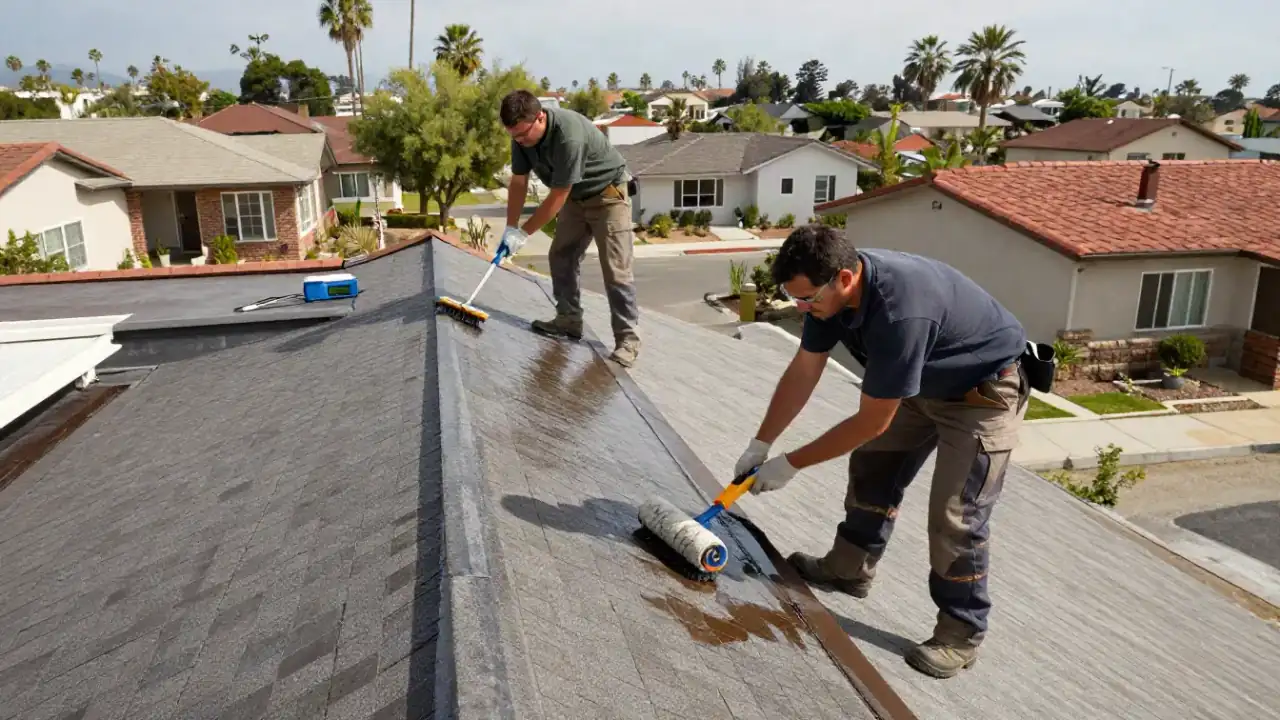
Roof leaks are found by testing the roof with controlled water while someone inside watches the ceiling, then confirming the entry point with an attic inspection, moisture meter, and infrared scan. That is the short answer, and it is the same sequence we run on nearly every roof leak inspection in Whittier. The long answer is that the wet spot on your ceiling is usually 6 to 15 feet away from the actual hole, so guessing from the ground wastes time and money. Below we walk through each roof leak detection method we use, what it costs in 2026, and how to tell when a leak is beyond a Saturday afternoon fix.
Why a Leak Almost Never Shows Up Where It Starts
Water enters at the highest point it can and exits at the lowest point it can, which is why the stain on your ceiling rarely sits under the damaged shingle. On a typical Whittier ranch home with a 4/12 pitch, water that gets in at a cracked pipe boot can travel along the felt underlayment for 10 feet before it drips through the drywall. Gravity, deck slope, and insulation all redirect it.
That travel is the whole reason roof leak detection methods in Whittier CA start with tracing, not patching. If we climb up and seal the shingle nearest the ceiling stain, we have fixed nothing. The leak keeps running, the stain keeps growing, and by the time you notice the second one you are looking at rotted sheathing instead of a $300 repair.
Three things push water sideways once it is inside the roof assembly:
- Underlayment channels. Felt and synthetic membranes carry water along their surface until they hit a seam or a fastener.
- Rafter bays. Water follows the low side of a rafter, which can be perpendicular to the direction you expect.
- Insulation. Blown-in insulation soaks water like a sponge and releases it slowly, sometimes days after a storm.
We see this constantly in the older housing stock around Roof Leak Repair in Uptown Whittier, where 1920s and 1930s homes have had three or four reroofs layered over original skip sheathing. Water can travel through every one of those layers before it shows up inside.
The First 30 Minutes: Attic and Interior Inspection
Attic and interior inspection is the fastest way to narrow down where a roof leak is entering, and it costs nothing but a flashlight and a willingness to get dusty. Before we touch a hose, we go inside.
Here is what we are looking for, in order:
- Active drips. If it is raining, we mark each drip with tape and a timestamp. Two drips 3 feet apart usually mean two separate entry points.
- Staining patterns on the roof deck. Dark streaks, rusted nail heads, and white mineral trails (efflorescence) all point uphill toward the source.
- Daylight through the deck. Any pinhole of light in the sheathing is a direct path for water.
- Moisture readings. A pin-type meter reads 12 to 15 percent on dry framing and 25 percent or higher on wet wood. We take readings every 4 feet along the suspected path.
If you have a ceiling stain, we also inspect the drywall itself. A brown ring with a soft center means the leak is active. A dry, crusty ring with a hard center usually means an old leak that has already stopped, and the repair may be cosmetic. That distinction saves homeowners money more often than any tool on the truck.
For stains that keep reappearing after a patch, we run a full ceiling leak detection Whittier visit, which adds thermal imaging and a deck-by-deck moisture map.
What Is Water Testing for Roof Leaks in Whittier California?
Water testing for roof leaks in Whittier California is the controlled application of water to one section of roof at a time while a second person watches inside for the leak to appear. It is the single most reliable way to confirm an entry point, because it reproduces the actual failure instead of inferring it.
The key word is controlled. We never flood a roof. We work bottom-up in 3-foot sections, starting at the eave and moving toward the ridge, and we pause 5 to 10 minutes between sections. Water takes time to travel. If you spray the whole roof at once and a drip appears, you have learned nothing except that the roof leaks somewhere.
A proper water test uses:
- A garden hose with a fan spray nozzle, not a pressure washer. Pressure washers drive water under shingles and create leaks that were not there before.
- Low flow, roughly 2 to 3 gallons per minute, aimed uphill so water behaves like rain running down the slope.
- A spotter in the attic or below the ceiling stain with a phone on speaker, calling out the moment water appears.
- A 20 to 30 minute window per suspect area. Most tests run 45 to 90 minutes total.
We do not water test in two situations: when the roof is already saturated from recent rain, and when the pitch is steep enough that walking it wet is unsafe. In those cases we switch to infrared and moisture metering, which we cover below.
How Are Roof Leaks Found in Whittier CA? The Four Testing Methods We Use
Roof leaks in Whittier are found with four methods, and we usually combine at least two on the same roof because each one catches what the others miss. No single tool finds every leak.
1. Water Testing With a Hose
This is the workhorse. It confirms the entry point with 100 percent certainty when the conditions allow. We use it most on shingle and tile roofs with accessible attics, and it is the method we trust when a homeowner has already paid someone to patch the wrong spot.
2. Infrared Thermal Imaging
An infrared camera reads surface temperature. Wet roof decking and wet insulation are cooler than dry material because evaporating water pulls heat away, so a wet rafter bay shows up as a dark blue signature against the warmer surrounding wood. On a Whittier afternoon in the high 80s, the temperature difference between wet and dry decking runs 8 to 15 degrees Fahrenheit, which is more than enough contrast to read.
Infrared is fast and non-invasive, and it works on roofs we cannot safely walk. Its limit is that it shows where moisture is, not how it got there. We still confirm with a meter and, when possible, a water test.
3. Moisture Meters
A pin meter gives us a number, and numbers settle arguments. Dry framing in a Whittier attic reads 10 to 14 percent. Anything above 20 percent is wet, and above 28 percent means the wood has been wet long enough to be at risk for dry rot and mold. We map readings across the whole attic, not just the area under the stain, because the wettest reading is usually closest to the source.
4. Smoke and Pressure Testing
For stubborn leaks that only appear during wind-driven rain, we pressurize the attic with a fan and introduce a small amount of theatrical smoke at the suspected penetration. If smoke escapes through a vent boot or a flashing seam, air is moving through that gap, and so is water during a storm. This is the method that finally cracks leaks other inspectors have written off as unfindable.
Roof Leak Inspection Methods in Whittier California: Matching the Method to the Roof
Roof leak inspection methods in Whittier California have to change with the roof, because a 1920s bungalow and a 1990s tract home fail in completely different places. Knowing where each roof type fails is half the job.
Shingle roofs. Most leaks start at penetrations, not in the field of shingles. Pipe boots, nail pops, and step flashing account for the majority of what we find. When the damage is limited to a few courses, Shingle Repair Whittier CA is a same-day fix.
Tile roofs. Tile itself almost never leaks. The underlayment beneath it does, and it fails on a predictable 20 to 25 year cycle. A cracked tile lets water through, but the leak is really the aged felt underneath.
Flat and low-slope roofs. These fail at seams, drains, and anywhere ponding water sits for more than 48 hours after a storm. We find them by flooding specific low spots and watching from below.
Chimneys and skylights. These are the two most common leak sources we get called out for, and both fail at the flashing, not the unit. Counter-flashing that has lifted a quarter inch is enough to let in a steady drip during a hard rain.
Whittier sits in a spot where this matters. Our rainy season runs roughly November through March, and a single atmospheric river can drop 3 to 5 inches in 48 hours. Roofs that stayed dry all summer suddenly leak in the first real storm, which is why we get most of our calls in December and January.
If you are searching for roof leak detection Whittier in the middle of a storm, the honest answer is that we can usually stop the water the same day and do the permanent repair once the roof dries out.
How Much Does Roof Leak Detection Cost in Whittier?
Roof leak detection in Whittier runs $250 to $600 in 2026 for a standard residential inspection, and that fee is credited toward the repair when you hire us to fix what we find. The range depends on roof size, pitch, and how many suspect areas need testing.
Here is what drives the number up or down:
- Roof size. A 1,200 square foot home takes about an hour. A 3,000 square foot home with multiple roof planes takes three.
- Access. A steep two-story roof or a tile roof that has to be walked carefully adds labor.
- Number of leaks. One leak is a diagnostic. Three leaks on the same roof is a pattern, and we test each one.
- Attic access. A finished attic with no hatch makes interior inspection harder and slower.
For comparison, the repair itself usually runs $350 to $900 for a flashing or pipe boot fix, and $1,500 to $4,500 when sheathing and underlayment have to be replaced. Finding the leak correctly the first time is what keeps you in the lower range.
Common Mistakes Homeowners Make Before They Call Us
The most expensive mistake we see is sealing the shingle directly above the ceiling stain. That shingle is almost never the source, and the sealant hides the evidence we need to trace the real one.
Other mistakes that cost homeowners money:
- Climbing a wet roof. Every year we hear about a fall that started with a homeowner trying to spot a leak during a storm. Wait for dry conditions or call us.
- Using a pressure washer. It forces water under shingles and flashing and creates new leaks in a roof that was only leaking in one place.
- Patching with roof cement over a wet surface. Sealant will not bond to wet shingles. The patch peels within a season and you are back where you started.
- Ignoring a slow drip. A drip every 30 seconds adds up to roughly 5 gallons a day, which is more than enough to rot a rafter and grow mold in a Whittier attic.
- Assuming the insurance claim is automatic. Sudden storm damage is usually covered. Long-term neglect is not, and a proper inspection report is what separates the two.
When to Call a Professional
Call us when the leak is active during rain, when the ceiling stain has grown past 6 inches, when you can see sagging drywall, or when you have already patched once and the water came back. Those four situations mean the entry point is not where you think it is.
We also want to hear from you if the leak only shows up in wind-driven rain, if the attic smells musty, or if the water is running down a wall instead of dripping from a ceiling. Those are the cases where a hose test alone will not find it and we need infrared or pressure testing.
Whittier Roof Leak Repair handles the whole job: we find the leak, fix it, and water test the repair before we pack up. You get a written report of what we found and photos of the entry point, which is useful if you decide to file a claim.
Frequently Asked Questions
How are roof leaks found in Whittier CA?
We start with an attic inspection and moisture meter readings, then confirm the entry point with a controlled hose water test, infrared imaging, or smoke pressure testing. Most leaks are located within 45 to 90 minutes. The method depends on roof type, pitch, and whether the leak is active during the visit.
What is water testing for roof leaks in Whittier California?
It is applying water to one 3-foot section of roof at a time with a low-flow hose while a second person watches inside for the drip. We work bottom-up and pause 5 to 10 minutes between sections. It confirms the exact entry point rather than guessing from the ceiling stain.
How much does roof leak detection cost in Whittier?
Expect $250 to $600 in 2026 for a residential inspection, depending on roof size, pitch, and how many areas need testing. We credit that fee toward the repair when you hire us. Repairs typically run $350 to $900 for flashing or pipe boot fixes.
Who does roof leak inspection near me in Whittier CA?
Whittier Roof Leak Repair inspects and repairs roofs across Whittier and the surrounding neighborhoods, including Uptown, Friendly Hills, East Whittier, and North Whittier. We handle shingle, tile, flat, and low-slope roofs, plus chimney, skylight, and valley leaks.
Can you find a leak when it is not raining?
Yes. Water testing, infrared imaging, and moisture meters all work on a dry day. The only leaks we cannot confirm without rain are wind-driven leaks that require storm conditions; for those we use smoke pressure testing to identify the gap.
Get Help With Roof Leak Repair in Whittier
If water is showing up on your ceiling and you cannot trace it, we will find it and fix it. Call Whittier Roof Leak Repair at (562) 443-3829 and we will schedule a roof leak inspection at your home.